

Exercise 5.1 - Chapter 5 - Differential Calculus - 11th Business Maths Guide Samacheer Kalvi Solutions
Updated On 26-08-2025 By Lithanya
You can Download the Exercise 5.1 - Chapter 5 - Differential Calculus - 11th Business Maths Guide Samacheer Kalvi Solutions with expert answers for all chapters. Perfect for Tamil & English Medium students to revise the syllabus and score more marks in board exams. Download and share it with your friends
Share this to Friend on WhatsApp
Chapter 5.1 - Differential Calculus - 11th Business Maths Guide Samacheer Kalvi Solutions - Text Book Back Questions and Answers
Text Book Back Questions and Answers
Question 1.
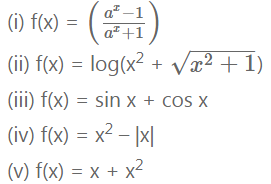
Determine whether the following functions are odd or even?
Solution:
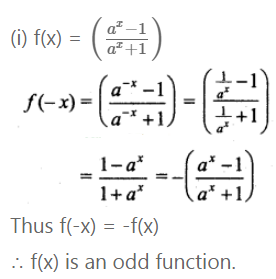
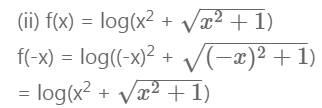
Thus f(-x) = f(x)
∴ f(x) is an even function.
(iii) f(x) = sin x + cos x
f(-x) = sin(-x) + cos(-x)
= -sin x + cos x
= -[sin x – cos x]
Since f(-x) ≠ -f(x) (or) f(x) ≠ -f(x)
∴ f(x) is neither odd nor even function.
(iv) Given f(x) = x2 – |x|
f(-x) = (-x)2 – |-x|
= x2 – |x|
= f(x)
∴ f(x) is an even function.
(v) f(x) = x + x2
f(-x) = (-x) + (-x)2 = -x + x2
Since f(-x) ≠ f(x), f(-x) ≠ -f(x).
∴ f(x) is neither odd nor even function.
Question 2.
Let f be defined by f(x) = x3 – kx2 + 2x, x ∈ R. Find k, if ‘f’ is an odd function.
Solution:
For a polynomial function to be an odd function each term should have odd powers pf x. Therefore there should not be an even power of x term.
∴ k = 0.
Question 3.

Question 4.

Solution:

Hence proved.
Question 5.

Solution:

Question 6.
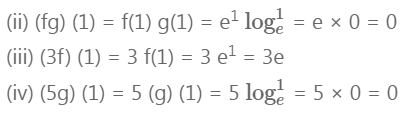
If f(x) = ex and g(x) = loge x then find
(i) (f + g) (1)
(ii) (fg) (1)
(iii) (3f) (1)
(iv) (5g) (1)
Solution:
(i) (f+g) (1) = e1 + loge 1 = e + 0 = e
Question 7.
Draw the graph of the following functions:
(i) f(x) = 16 – x2
(ii) f(x) = |x – 2|
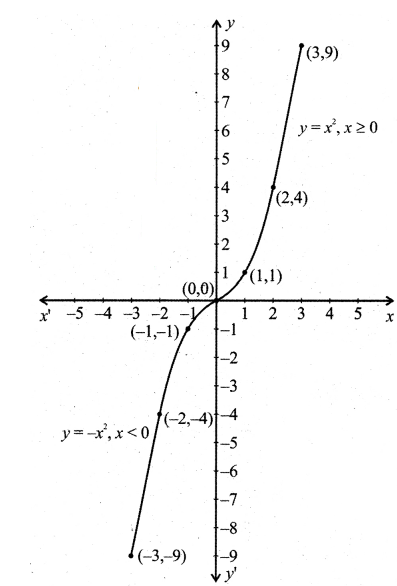
(iii) f(x) = x|x|
(iv) f(x) = e2x
(v) f(x) = e-2x

Solution:
(i) f(x) = 16 – x2
Let y = f(x) = 16 – x2
Choose suitable values for x and determine y. Thus we get the following table.

Plot the points (-4, 0), (-3, 7), (-2, 12), (-1, 15), (0, 16), (1, 15), (2, 12), (3, 7), (4, 0).
The graph is as shown in the figure.

(ii) Let y = f(x) = |x – 2|


Plot the points (2, 0), (3, 1) (4, 2), (5, 3), (0, 2), (-1, 3), (-2, 4), (-3, 5) and draw a line.
The graph is as shown in the figure.

(iii) Let y = f(x) = x|x|


Plot the points (0, 0), (1, 1) (2, 4), (3, 9), (-1, -1), (-2, -4), (-3, -9) and draw a smooth curve.
The graph is as shown in the figure.
(iv) For x = 0, f(x) becomes 1 i.e., the curve cuts the y-axis at y = 1.
For no real value of x, f(x) equals to 0. Thus it does not meet the x-axis for real values of x.

(v) For x = 0, f(x) becomes 1 i.e., the curve cuts the y-axis at y = 1.
For no real value of x, f(x) equal to 0. Thus it does not meet the x-axis for real values of x.

(vi) If f: R → R is defined by


The domain of the function is R and the range is {-1, 0, 1}.