

Text Book Back Questions and Answers - Chapter 9 - Ratio Analysis - 12th Accountancy Guide Samacheer Kalvi Solutions
Updated On 26-08-2025 By Lithanya
You can Download the Text Book Back Questions and Answers - Chapter 9 - Ratio Analysis - 12th Accountancy Guide Samacheer Kalvi Solutions with expert answers for all chapters. Perfect for Tamil & English Medium students to revise the syllabus and score more marks in board exams. Download and share it with your friends
Share this to Friend on WhatsApp
Samacheer Kalvi 12th Accountancy Solutions Chapter 9 Ratio Analysis - Text Book Back Questions and Answers
I. Choose the Correct Answer
Question 1.
The mathematical expression that provides a measure of the relationship between two figures is called ……………..
(a) Conclusion
(b) Ratio
(c) Model
(d) Decision
Answer:
(b) Ratio
Question 2.
Current ratio indicates ……………..
(a) Ability to meet short term obligations
(b) Efficiency of management
(c) Profitability
(d) Long term solvency
Answer:
(a) Ability to meet short term obligations
Question 3.
Current assets excluding inventory and prepaid expenses is called ……………..
(a) Reserves
(b) Tangible assets
(c) Funds
(d) Quick assets
Answer:
(d) Quick assets
Question 4.
Debt equity ratio is a measure of ……………..
(a) Short term solvency
(b) Long term solvency
(c) Profitability
(d) Efficiency
Answer:
(b) Long term solvency
Question 5.
Match List I with List II and select the correct answer using the codes given below:

Answer:
(a) 1 4 3 2
Question 6.
To test the liquidity of a concern, which of the following ratios are useful?
(i) Quick ratio
(ii) Net profit ratio
(iii) Debt – equity ratio
(iv) Current ratio
Select the correct answer using the codes given below:
(a) (i) and (ii)
(b) (i) and (iv)
(c) (ii) and (iii)
(d) (ii) and (iv)
Answer:
(b) (i) and (iv)
Question 7.
Proportion of share holder’s funds to total assets is called ……………..
(a) Proprietary ratio
(b) Capital gearing ratio
(c) Debt equity ratio
(d) Current ratio
Answer:
(a) Proprietary ratio
Question 8.
Which one of the following is not correctly matched?
(a) Liquid ratio – Proportion
(b) Gross profit ratio – Percentage
(c) Fixed assets turnover ratio – Percentage
(d) Debt – equity ratio – Proportion
Answer:
(c) Fixed assets turnover ratio – Percentage
Question 9.
Current liabilities 40,000; Current assets 1,00,000 ; Inventory 20,000 . Quick ratio is ……………..
(a) 1:1
(b) 2.5:1
(c) 2:1
(d) 1:2
Answer:
(c) 2:1
Question 10.
Cost of revenue from operations 3,00,000; Inventory in the beginning of the year 60,000; Inventory at the close of the year 40,000. Inventory turnover ratio is
(a) 2 times
(b) 3 times
(c) 6 times
(d) 8 times
Answer:
(c) 6 times
II. Very short answer questions
Question 1.
What is meant by accounting ratios?
Answer:
Ratio is a mathematical expression of relationship between two related or interdependent items. It is the numerical or quantitative relationship between two items. It is calculated by dividing one item by the other related item. When ratios are calculated on the basis of accounting information, these are called ‘accounting ratios’.
Question 2.
What is quick ratio?
Answer:
Quick ratio gives the proportion of quick assets to current liabilities. It indicates whether the business concern is in a position to pay its current liabilities as and when they become due, out of its quick assets. Quick assets are current assets excluding inventories and prepaid expenses. It is otherwise called “liquid ratio” or “acid test ratio”.

Quick assets = Current assets – Inventories – Prepaid expenses.
Higher the quick ratio, better is the short – term financial position of an enterprise.
Question 3.
What is meant by debt equity ratio?
Answer:
It is calculated to assess the long term solvency position of a business concern. Debt equity ratio expresses the relationship between long term debt and shareholder’s funds.

Capital employed = Shareholder’s funds + Non current liabilities
Greater the return on investment better is the profitability of a business and vice versa.
Question 4.
What does return on investment ratio indicate?
Answer:
It shows the proportion of net profit before interest and tax to capital employed (shareholder’s fund and long term debts). It is an overall measure of profitability of a business concern.

Capital employed = Shareholder’s funds + Non current liabilities
Greater the return on investment better is the profitability of a business and vice versa.
Question 5.
State any two limitations of ratio analysis.
Answer:
Ratios are only means: Ratios are not end in themselves but they are only means to achieve a particular purpose. Analysis of related items must be done by the management or experts with the help of ratios. Change in price level: Ratio analysis may not reflect price level changes and current values as they are calculated based on historical data given in financial statement.
III. Short answer questions
Question 1.
Explain the objectives of ratio analysis.
Answer:
The objectives of ratio analysis:
1. To simplify accounting figures
2. To facilitate analysis of financial statements
3. To analysis the operational efficiency of a business
4. To help in budgeting and forecasting
5. To facilitate intra firm and inter firm comparison of performance
Question 2.
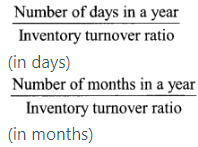
What is inventory conversion period? How is it calculated?
Answer:
It is the time taken to sell the inventory. A shorter inventory conversion period indicates more efficiency in the management of inventory. It is computed as follows:
Question 3.
How is operating profit ascertained?
Answer:
It gives the proportion of operating profit to revenue from operations. Operating profit ratio is an indicator of operational efficiency of an organisation. It may be computed as follows:

Alternatively, it is calculated as under:
Operating profit ratio = 100 – Operating cost ratio
Operating profit = Revenue from operations – Operating cost
Question 4.
State any three advantages of ratio analysis.
Answer:
1. Measuring operational efficiency: Ratio analysis helps to know operational efficiency of a business by finding the relationship between operating cost and revenues and also by comparison of present ratios with those of the past ratios.
2. Intra firm comparison: Comparison of efficiency of different divisions of an organisation is possible by comparing the relevant ratios.
3. Inter firm comparison: Ratio analysis helps the firm to compare its performance with other firms.
Question 5.
Bring out the limitations of ratio analysis.
Answer:
Following are the limitations of ratio analysis:
1. Ratios are only means: Ratios are not end in themselves but they are only means to achieve a particular purpose. Analysis of related items must be done by the management or experts with the help of ratios.
2. Accuracy of financial information: The accuracy of a ratio depends on the accuracy of information taken from financial statements. If the statements are inaccurate, ratios computed based on that will also be inaccurate.
3. Consistency in preparation of financial statements: Inter firm comparisons with the help of ratio analysis will be meaningful only if the firms follow uniform accounting procedures consistently.
4. Non – availability of standards or norms: Ratios will be meaningful only if they are compared with accepted standards or norms. Only few financial ratios have universally recognised standards. For other ratios, comparison with standards is not possible.
5. Change in price level: Ratio analysis may not reflect price level changes and current values as they are calculated based on historical data given in financial statements.
IV. Exercises
Question 1.
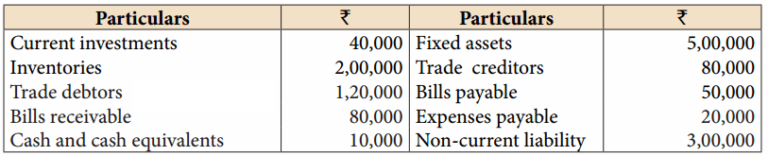
Calculate the current ratio from the following information.
Solution:

Current assets = current investment + Inventories + Trade debtors + Bills receivable + Cash and cash equivalents
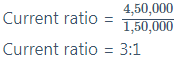
C. A = 40,000 + 2,00,000 + 1,20,000 + 80,000 + 10,000 = 4,50,000
Current liablities = Trade crditors + Bills payable + Expenses payable
C.L = 80,000 + 50,000 + 20,000
= 1,50,000
Question 2.
Calculate quick ratio: Total current liabilities 2,40,000; Total current assets 4,50,000; Inventories 70,000; Prepaid expenses 20,000
Solution:

Quick ratio = Current assets – Inventory – Prepaid expenses = 4,50,000 – 70,000 – 20,000
= 3,60,000

Question 3.
Following is the balance sheet of Lakshmi Ltd. as on 31st March, 2019:

Calculate:
(i) Current ratio (ii) Quick ratio
Solution:

Current ratio = 1.5:1
Current assets = Inventories + Trade debtors + Cash and cash equivalents + other current assets prepaid expenses.
= 40,000 + 1,60,000 + 3,20,000 + 80,000
= 6,00,000
Current Liabilities = short-term loans + trade payables + Expenses payable + short term provision.
= 50,000 + 3,10,000 + 15,000 + 25,000
= 4,00,000

Quick assets = Current assets – Inventory – Prepaid expenses
= 6,00,000 – 1,60,000 – 40,000 = 4,00,000

Question 4.
From the following information calculate debt equity ratio.
Balance sheet (Extract) as on 31st March, 2019:

Solution:

Debentures = 6,00,000
Shareholders’ funds = Equity share capital + Reserves and surplus
= 6,00,000 + 2,00,000
= 8,00,000

Question 5.
From the following Balance Sheet of Pioneer Ltd. calculate proprietary ratio:
Balance sheet of Pioneer Ltd. as on 31.3.2019

Solution:

Shareholders’ funds = Equity share capital + Preference share capital + Reserves and surplus
= 2,50,000 + 1,50,000 + 50,000
= 4,50,000
Total tanginle assets = Fixed assets capital + preference share capital + Reserves and surplus
= 2,50,000 + 1,00,000 + 40,000
=6,00,000

Question 6.
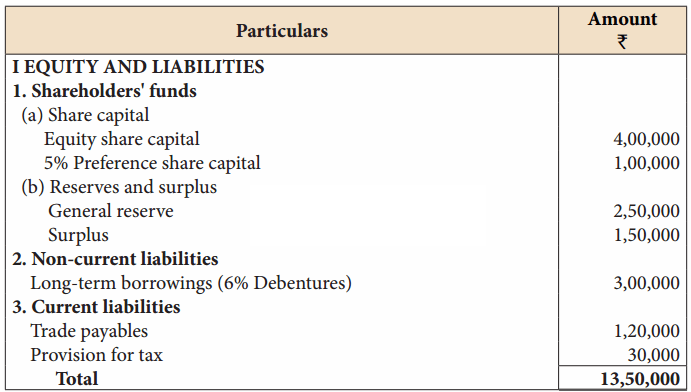
From the following information calculate capital gearing ratio:
Balance Sheet (Extract) as on 31.03.2018
Solution:

Funds bearing fixed interest and dividend Preference share capital + Debentures
= 1,00,000 + 3,00,000 = 4,00,000
Equity shareholder’s funds = Equity share capital + General reserve + Surplus
= 4,00,000 + 2,50,000 + 1,5,000 = 8,00,000
Question 7.
From the following Balance Sheet of Arunan Ltd. as on 31.03.2019 calculate
1. Debt – equity ratio
2. Proprietary ratio
3. Capital gearing ratio
Balance Sheet of Arunan Ltd. as on 31.03.2019

Solution:

Long term debt = Debentures = 3,00,000
Shareholders’ funds = Equity share capital + Preference share capital + Reserves and surplus
= 2,50,000 + 2,00,000 + 1 ,50,000
= 6,00,000

Debt – equity ratio : 0.5 : 1
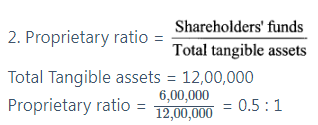

Funds bearing fixed interest or dividend = Preference share capital + Debentures + Long term borrowings.
= 2,00,000 + 4,00,000 = 5,00,000
Equity shareholders’ funds = Equity share capital + Reserves and surplus
= 2,50,000 + 1,50,000 = 4,00,000

Question 8.
From the given information calculate the inventory turnover ratio and inventory conversion period (in months) of Sania Ltd.

Solution:

Cost of revenue from operations = Opening inventory + Net Purchases + Direct expenses (carriage inwards) – Closing inventory
= 1,70,000 + 6,90,000 + 20,000 – 1,30,000
= 7,50,000

Question 9.
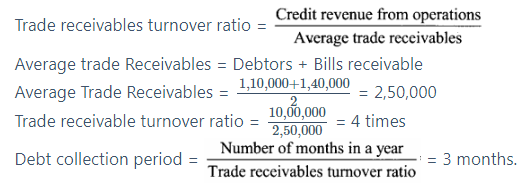
The credit revenue from operations of Harini Ltd. amounted to 9,60,000. Its debtors and bills receivable at the end of the accounting period amounted to 1,00,000 and 60,000, respectively. Calculate trade receivable turnover ratio and also collection period in months.
Solution:
Question 10.
From the following figures obtained from Kalpana Ltd, calculate the trade payables turnover ratio and credit payment period (in days).

Solution:


Question 11.
From the following information of Ashika Ltd., calculate fixed assets turnover ratio:
1. Revenue from operations during the year were 60,00,000.
2. Fixed assets at the end of the year was 6,00,000.
Solution:

Question 12.
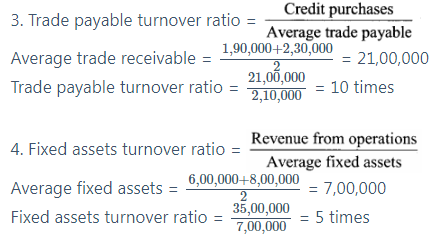
Calculate:
1. Inventory turnover ratio
2. Trade receivable turnover ratio
3. Trade payable turnover ratio and
4. Fixed assets turnover ratio from the following information obtained from Delphi Ltd.

Additional information:
1. Revenue from operations for the year ₹ 10,50,000
2. Purchases for the year ₹ 4,50,000
3. Cost of revenue from operations ₹ 6,00,000. Assume that sales and purchases are for credit.
Solution:

Question 13.
Calculate gross profit ratio from the following:
Revenue from operations 1,00,000, Cost of revenue from operations 80,000 and purchases 62,500.
Solution:

Gross profit = Revenue from operations – Cost of revenue from operations
= 2,50,000 – 2,10,000
= 40,000

Question 14.
Following is the statement of profit and loss of Maria Ltd. for the year ended 31st March, 2018. Calculate the operating cost ratio.
Statement of Profit and Loss

Notes to Accounts

Solution:

Cost of revenue from operations = Purchases of stock-in-trade + Change in inventories of stock
= 8,60,000 + 40,000 = 9,00,000
Operating expenses = office and administrative expenses + Selling and distribution expenses + Employee benefits expenses salaries
= 50,000 + 90,000 + 1,60,000 = 3,00,000
Operating cost = Cost of revenue from operations + Operating expenses
= 9,00,000 + 3,00,000
= 12,00,000

Question 15.
Calculate operating profit ratio under the following cases.
Case 1: Revenue from operations 10,00,000, Operating profit 1,50,000.
Case 2: Revenue from operations 15,00,000, Operating cost 12,00,000.
Case 3: Revenue from operations 20,00,000, Gross profit 30% on revenue from operations, Operating expenses 4,00,000
Solution:

Case II.
Operating profit = Revenue from operation – Operating Cost
= 20,00,000 – 14,00,000 = 6,00,000

Case III.
Operating profit = Gross profit – Operating expenses

Question 16.
From the following details of a business concern calculate net profit ratio.

Solution:

Net profit = Revenue from operations – Cost of revenue from operation – office and administrative expenses – selling and distribution expenses

Question 17.
From the following statement of profit and loss of Mukesh Ltd. calculate
1. Gross profit ratio
2. Net profit ratio.
Statement of Profit and Loss

Solution:

Gross profit = Revenue from operations – Purchase of stock in trade – Changes in inventories
= 24,00,000 – 18,80,000 – ( – 80,000)
= 6,00,000

Question 18.
From the following trading activities of Naveen Ltd. calculate
1. Gross profit ratio
2. Net profit ratio
3. Operating cost ratio
4. Operating profit ratio
Statement of Profit and loss
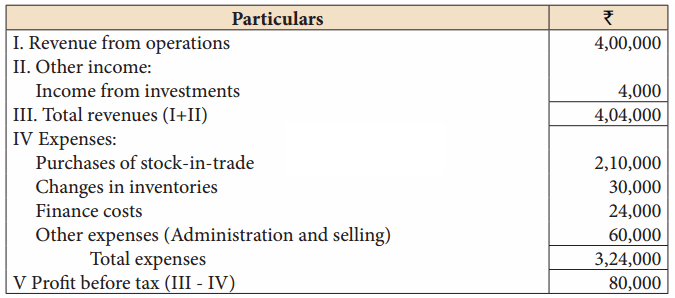
Solution:

Gross profit = Revenue from operations – Purchase of stock in trade – Changes in inventories
= 44,00,000 – 21,00,000 – 30,000
= 16,00,000


Cost of revenue from operations = Purchases of stock-in-trade + Change in inventories of stock
= 2,10,000 + 30,000 = 2,40,000
Operating expenses = Administrative expenses + Selling and expenses = 60,000
Operating cost = 2,40,000 + 60,000 = 3,00,000


Operating profit = Gross profit – Operating expenses
= 1,60,000 – 60,000 = 1,00,000

Question 19.
Following is the extract of the balance sheet of Babu Ltd., as on 31st March, 2018:
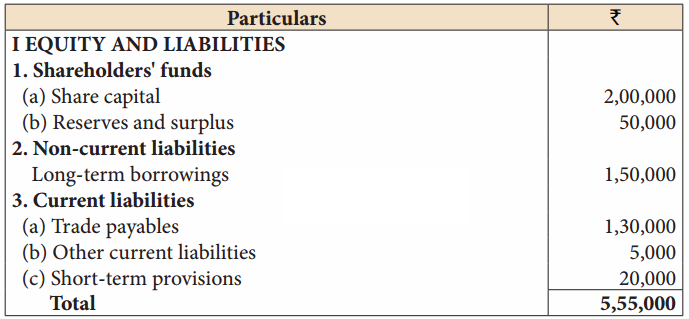
Net profit before interest and tax for the year was ₹ 25,000. Calculate the return on capital employed for the year.
Solution:

Capital employed = Share capital + Reserves and surplus + Long term borrowings
= 2,00,000 + 50,000 + 1,50,000 = 4,00,000

Very Short Answer Questions
Question 1.
What are liquidity ratios?
Answer:
Liquidity ratios are the ratios meant for testing short term solvency position of the firm, i.e., Whether a company is able to repay the short-term loans their due dates. They include
1. Current ratio and
2. Liquid ratio.
Question 2.
What are activity ratio?
Answer:
Activity ratios measure the effectiveness with which assets are used for generating revenue from operations.They include
1. Inventory turnover ratio and
2. Trade receivable turnover ratio and
3. Working capital turnover ratio, etc.
II. Exercise
Question 1.
From the following complete (i) current ratio, (ii) Quick ratio.

Solution:

Current assets = Current investments + Inventories + Trade receivables + Cash and cash + short – term loans and Advances
= 40,000 + 5,000 + 2,000 + 10,000 + 4,000 = 61,000
Current liabilities = Short – term borrowings + Trade payable + short-term provisions + other current liabilities
= 20,000 + 2,500 + 3,000 + 5,000 = 30,500

Question 2.
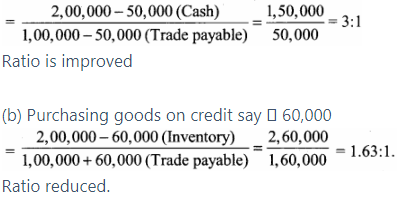
Current ratio = 2:1. State and give reason which of the following would improve, reduce or does not change the ratio
(a) Repayment of current liabilities
(b) Purchasing goods on credit
(c) Sale of office equipments for 4000 (book value 5000)
(d) Sale of goods 11,000 (cost 10,000)
(e) Payment of dividend
Answer:
Current ratio of a company is 2:1. In other words, it may be assumed that the current assets are 2,00,000 and current liabilities are 1,00,000.
(a) Repayment of current liabilities say 50,000

Question 3.
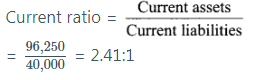
Calculate current ratio of a company from the following information
Inventory turnover ratio = 4 times
Inventory in the end was 20,000 more than inventory in the beginning. Revenue from operations 3,00,000 Gross profit ratio = 25%
Current liabilities ₹ 40,000; Quick ratio 0.75:1
Cost of revenue from operations
Answer:
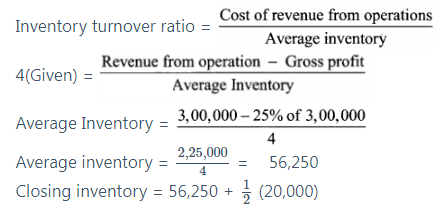
56,250 + 10,000 = 66,250
Current assets = Liquid assets + Closing inventory with the help of quick ratio. We can findout liquid assets.
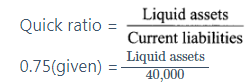
Liquid assets = 40,000 x 0.75 = 30,000
Current assets = Liquid assets + Inventory
= 30,000 + 66,250 = 96,250
Question 4.
From the given balance sheet of Mr. A, calculate the activity (turnover) ratios.
Balance sheet as on 31.12.2004

Additional Information: Credit purchase 5,00,000; credit sales 9,00,000
Answer:

Capital employed = Share capital + Profit and loss A/c + Reserve and surplus + debentures
= 2,00,000 + 1,00,000 + 1,00,000 + 50,000 = 4,50,000


Fixed assets = Land + Buildings + Equipments + Furniture = 50,000 + 1,00,000 + 1,75,000 + 75,000
= 3,00,000


Credit 9,00,000.
Average debtors = Closing debtors = 60,000


Question 5.
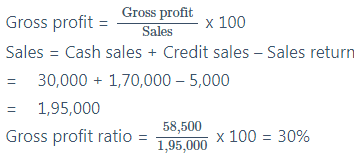
From the following particulars ascertain gross profit ratio:
Cash sales – 30,000
Gross profit – 1,58,500
Credit sales – 1,70,000
Return inward – 5,000
Answer:
Question 6.
Calculate current ratio
Cash 2,00,000; Sundry debtors 80,000
Stock 1,20,000; Sundry Creditors 1,50,000
Bills payable 50,000
Answer:

Question 7.
Calculate Liquidity ratio
Current assets – 20,000
Prepaid expenses – 1,000
Stock – 3,000
Current liabilities – 8,000
Answer:

Liquid assets = Current assets – (stock + Prepaid exp)
= 20,000 – (3000+ 1000)
= 20,000 – 4000 = 16,000 Current liabilities = 8,000

Question 8.
Calculate Debt – Equity ratio.
Equity share capital 2,00,000; General reserve 1,50,000; Long term loan Debt – Equity 50,000; Debenture 1,00,000.
Answer:

Total long term debt = debentures + long term loan = 1,00,000 + 50,000 = 1,50,000
Shareholders fund = Equity share capital + General reserve
= 2,00,000 + 1,50,000
= 3,50,000

Question 9.
From the following calculate gross profit ratio:
Gross profit 50,000 Sales 5,50,000
Sales return = 50,000
Answer:

Question 10.
Calculate gross profit ratio:
Sales 6,50,000; Cost of goods sold 4,80,000; Sales returns 50,000.
Answer:

Question 11.
Calculate capital turnover ratio:
Sales 20,40,000; Equity share capital 2,00,000
Preference share capital 1,00,000; Sales return 40,000
Loan 50,000; Reserve 50,000.
Answer:

Sales = Sales – Sales returns
= 20,40,000 – 40,000
= 20,00,000
Capital employed = Equity share capitals + Preference share capital + Reserve + Loans
= 2,00,000 + 1,00,000 + 50,000 + 50,000
= 4,00,000

Question 12.
From the following data, calculate the fixed assets turnover ratio: 6,00,000; fixed assets depreciation 2,00,000 Total sales 17,00,000; Sales returns 1,00,000.
Answer:

Sales = Total sales – Sales returns
= 17,00,000 – 1,00,000
= 16,00,0000
Fixed assets = Fixed assets – depreciation
= 6,00,000 – 2,00,000
= 4,00,000

Question 13.
Calculate Stock – Turnover ratio:
Opening stock = 80,000; Closing stock 60,000; Purchases 1,90,000.
Answer: