

Exercise 2.5 - Chapter 2 - Algebra - 11th Business Maths Guide Samacheer Kalvi Solutions
Updated On 26-08-2025 By Lithanya
You can Download the Exercise 2.5 - Chapter 2 - Algebra - 11th Business Maths Guide Samacheer Kalvi Solutions with expert answers for all chapters. Perfect for Tamil & English Medium students to revise the syllabus and score more marks in board exams. Download and share it with your friends
Share this to Friend on WhatsApp
Exercise 2.5
Text Book Back Questions and Answers
By the principle of mathematical induction, prove the following:
Question 1.

Solution:
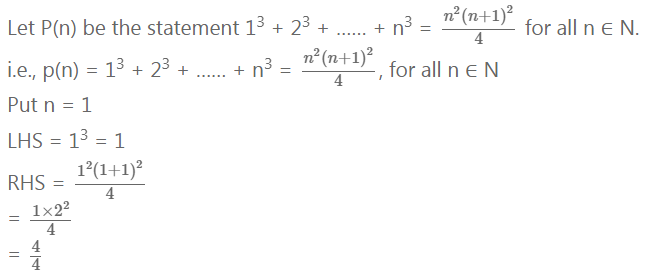
= 1
∴ P(1) is true.
Assume that P(n) is true n = k

⇒ P(k + 1) is true, whenever P(k) is true.
Hence, by the principle of mathematical induction P(n) is true for all n ∈ N.
Question 2.

Solution:
Let P(n) denote the statement

∴ P(1) is true.
Now assume that the statement be true for n = k
(i.e.,) assume P(k) be true

∴ P(k + 1) is true.
Thus if P(k) is true, P(k + 1) is true.
By the principle of Mathematical ‘induction, P(n) is true for all n ∈ N.

Question 3.
4 + 8 + 12 + ……. + 4n = 2n(n + 1), for all n ∈ N.
Solution:
Let P(n) denote the statement 4 + 8 + …….. + 4n = 2n(n + 1)
i.e., P(n) : 4 + 8 + 12 + … + 4n = 2n(n + 1)
Put n = 1,
P(1): LHS = 4
RHS = 2 (1)(1 + 1) = 4
P(1) is true.
Assume that P(n) is true for n = k
P(k): 4 + 8 + 12 + ……. + 4k = 2k(k + 1)
To prove P(k + 1)
i.e., to prove 4 + 8 + 12 + ……. + 4k + 4(k + 1) = 2(k + 1) (k + 1 + 1)
4 + 8 + 12 + …… + 4k + (4k + 4) = 2(k + 1) (k + 2)
Consider, 4 + 8 + 12 + …….. + 4k + (4k + 4) = 2k(k + 1) + (4k + 4)
= 2k(k + 1) + 4(k + 1)
= 2k2 + 2k + 4k + 4
= 2k2 + 6k + 4
= 2(k + 1)(k + 2)
P(k + 1) is also true.
∴ By Mathematical Induction, P(n) for all value n ∈ N.
Question 4.

Solution:

∴ P(1) is true.
Assume P(k) is true for n = k

∴ P(k + 1) is true whenever P(k) is true.
∴ By the Principle of Mathematical Induction, P(n) is true for all n ∈ N.
Question 5
32n – 1 is divisible by 8, for all n ∈ N.
Solution:
Let P(n) denote the statement 32n – 1 is divisible by 8 for all n ∈ N
Put n = 1
P(1) is the statement 32(1) – 1 = 32 – 1 = 9 – 1 = 8, which is divisible by 8
∴ P(1) is true.
Assume that P(k) is true for n = k.
i.e., 32k – 1 is divisible by 8 to be true.
Let 32k – 1 = 8m
To prove P(k + 1) is true.
i.e., to prove 32(k+1) – 1 is divisible by 8
Consider 32(k+1) – 1 = 32k+2 – 1
= 32k . 32 – 1
= 32k (9) – 1
= 32k (8 + 1) – 1
= 32k × 8 + 32k × 1 – 1
= 32k (8) + 32k – 1
= 32k (8) + 8m (∵ 32k – 1 = 8m)
= 8(32k + m), which is divisible by 8.
∴ P(k + 1) is true wherever P(k) is true.
∴ By principle of Mathematical Induction, P(n) is true for all n ∈ N.
Question 6.
an – bn is divisible by a – b, for all n ∈ N.
Solution:
Let P(n) denote the statement an – bn is divisible by a – b.
Put n = 1. Then P(1) is the statement: a1 – b1 = a – b is divisible by a – b
∴ P(1) is true. Now assume that the statement be true for n = k
(i.e.,) assume P(k) be true, (i.e.,) ak – bk is divisible by (a – b) be true.

⇒ ak – bk = m(a – b)
⇒ ak = bk + m(a – b) ……. (1)
Now to prove P(k + 1) is true, (i.e.,) to prove: ak+1 – bk+1 is divisible by a – b
Consider ak+1 – bk+1 = ak . a – bk . b
= [bk + m(a – b)] a – bk . b [∵ ak = bm + k(a – b)]
= bk . a + am(a – b) – bk . b
= bk . a – bk . b + am(a – b)
= bk(a – b) + am(a – b)
= (a – b) (bk + am) is divisible by (a – b)
∴ P(k + 1) is true.
By the principle of Mathematical induction. P(n) is true for all n ∈ N.
∴ an – bn is divisible by a – b for n ∈ N.
Question 7.
52n – 1 is divisible by 24, for all n ∈ N.
Solution:
Let P(n) be the proposition that 52n – 1 is divisible by 24.
For n = 1, P(1) is: 52 – 1 = 25 – 1 = 24, 24 is divisible by 24.
Assume that P(k) is true.
i.e., 52k – 1 is divisible by 24
Let 52k – 1 = 24m
To prove P(k + 1) is true.
i.e., to prove 52(k+1) – 1 is divisible by 24.
P(k): 52k – 1 is divisible by 24.
P(k + 1) = 52(k+1) – 1
= 52k . 52 – 1
= 52k (25) – 1
= 52k (24 + 1) – 1
= 24 . 52k + 52k – 1
= 24 . 52k + 24m
= 24 [52k + 24]
which is divisible by 24 ⇒ P(k + 1) is also true.
Hence by mathematical induction, P(n) is true for all values n ∈ N.
Question 8.
n(n + 1) (n + 2) is divisible by 6, for all n ∈ N.
Solution:
P(n): n(n + 1) (n + 2) is divisible by 6.
P(1): 1 (2) (3) = 6 is divisible by 6
∴ P(1) is true.
Let us assume that P(k) is true for n = k
That is, k (k + 1) (k + 2) = 6m for some m
To prove P(k + 1) is true i.e. to prove (k + 1) (k + 2)(k + 3) is divisible by 6.
P(k + 1) = (k + 1) (k + 2) (k + 3)
= (k + 1)(k + 2)k + 3(k + 1)(k + 2)
= 6m + 3(k + 1)(k + 2)
In the second term either k + 1 or k + 2 will be even, whatever be the value of k.
Hence second term is also divisible by 6.
∴ P (k + 1) is also true whenever P(k) is true.
By Mathematical Induction P (n) is true for all values of n.
Question 9.
2n > n, for all n ∈ N.
Solution:
Let P(n) denote the statement 2n > n for all n ∈ N
i.e., P(n): 2n > n for n ≥ 1
Put n = 1, P(1): 21 > 1 which is true.
Assume that P(k) is true for n = k
i.e., 2k > k for k ≥ 1
To prove P(k + 1) is true.
i.e., to prove 2k+1 > k + 1 for k ≥ 1
Since 2k > k
Multiply both sides by 2
2 . 2k > 2k
2k+1 > k + k
i.e., 2k+1 > k + 1 (∵ k ≥ 1)
∴ P(k + 1) is true whenever P(k) is true.
∴ By principal of mathematical induction P(n) is true for all n ∈ N.