
Exercise 3.3 - Chapter 3 - Analytical Geometry - 11th Business Maths Guide Samacheer Kalvi Solutions
Updated On 26-08-2025 By Lithanya
You can Download the Exercise 3.3 - Chapter 3 - Analytical Geometry - 11th Business Maths Guide Samacheer Kalvi Solutions with expert answers for all chapters. Perfect for Tamil & English Medium students to revise the syllabus and score more marks in board exams. Download and share it with your friends
Share this to Friend on WhatsApp
Exercise 3.3
Text Book Back Questions and Answers
Question 1.
If the equation ax2 + 5xy – 6y2 + 12x + 5y + c = 0 represents a pair of perpendicular straight lines, find a and c.
Solution:
Comparing ax2 + 5xy – 6y2 + 12x + 5y + c = 0 with ax2 + 2hxy + by2 + 2gx + 2fy + c = 0
We get a = a, 2h = 5, (or) h = 5/2, b = -6, 2g = 12 (or) g = 6, 2f = 5 (or) f = 5/2, c = c
Condition for pair of straight lines to be perpendicular is a + b = 0
a + (-6) = 0
a = 6
Next to find c. Condition for the given equation to represent a pair of straight lines is


Question 2.
Show that the equation 12x2 – 10xy + 2y2 + 14x – 5y + 2 = 0 represents a pair of straight lines and also find the separate equations of the straight lines.
Solution:
Comparing 12x2 – 10xy + 2y2 + 14x – 5y + 2 = 0 with ax2 + 2hxy + by2 + 2gh + 2fy + c = 0
We get a = 12, 2h = -10, (or) h = -5, b = 2, 2g = 14 (or) g = 7, 2f = -5 (or) f = −5/2, c = 2
Condition for the given equation to represent a pair of straight lines is

= 1/4 [12(16 – 25) + 5(-40 + 70) + 7(50 – 56)]
= 1/4 [12(-9) + 5(30) + 7(-6)]
= 1/4 [-108 + 150 – 42]
= 1/4 [0]
= 0
∴ The given equation represents a pair of straight lines.
Consider 12x2 – 10xy + 2y2 = 2[6x2 – 5xy + y2] = 2[(3x – y)(2x – y)] = (6x – 2y)(2x – y)
Let the separate equations be 6x – 2y + l = 0, 2x – y + m = 0
To find l, m
Let 12x2 – 10xy + 2y2 + 14x – 5y + 2 = (6x – 2y + l) (2x – y + m) ……. (1)
Equating coefficient of y on both sides of (1) we get
2l + 6m = 14 (or) l + 3m = 7 ………… (2)
Equating coefficient of x on both sides of (1) we get
-l – 2m = -5 ……… (3)
(2) + (3) ⇒ m = 2
Using m = 2 in (2) we get
l + 3(2) = 7
l = 7 – 6
l = 1
∴ The separate equations are 6x – 2y + 1 = 0, 2x – y + 2 = 0.
Question 3.
Show that the pair of straight lines 4x2 + 12xy + 9y2 – 6x – 9y + 2 = 0 represents two parallel straight lines and also find the separate equations of the straight lines.
Solution:
The given equation is 4x2 + 12xy + 9y2 – 6x – 9y + 2 = 0
Here a = 4, 2h = 12, (or) h = 6 and b = 9
h2 – ab = 62 – 4 × 9 = 36 – 36 = 0
∴ The given equation represents a pair of parallel straight lines
Consider 4x2 + 12xy + 9y2 = (2x)2 + 12xy + (3y)2
= (2x)2 + 2(2x)(3y) + (3y)2
= (2x + 3y)2
Here we have repeated factors.
Now consider, 4x2 + 12xy + 9y2 – 6x – 9y + 2 = 0
(2x + 3y)2 – 3(2x + 3y) + 2 = 0
t2 – 3t + 2 = 0 where t = 2x + 3y
(t – 1)(t – 2) = 0
(2x + 3y – 1) (2x + 3y – 2) = 0
∴ Separate equations are 2x + 3y – 1 = 0, 2x + 3y – 2 = 0
Question 4.
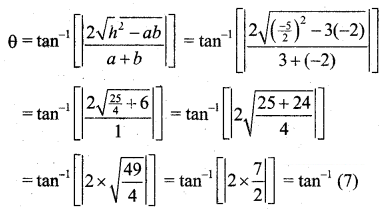
Find the angle between the pair of straight lines 3x2 – 5xy – 2y2 + 17x + y + 10 = 0.
Solution:
The given equation is 3x2 – 5xy – 2y2 + 17x + y + 10 = 0
Here a = 3, 2h = -5, b = -2
If θ is the angle between the given straight lines then