

Exercise 6.4 - Chapter 6 - Application of Differentiation - 11th Business Maths Guide Samacheer Kalvi Solutions
Updated On 26-08-2025 By Lithanya
You can Download the Exercise 6.4 - Chapter 6 - Application of Differentiation - 11th Business Maths Guide Samacheer Kalvi Solutions with expert answers for all chapters. Perfect for Tamil & English Medium students to revise the syllabus and score more marks in board exams. Download and share it with your friends
Share this to Friend on WhatsApp
Exercise 6.4
Text Book Back Questions and Answers
Question 1.
If z = (ax + b) (cy + d), then find 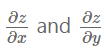
Solution:
Given, z = (ax + b) (cy + d)
Differentiating partially with respect to x we get, 
= (cy + d) (a + 0)
= a(cy + d)
Differentiating partially with respect to y we get,
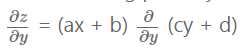
= (cy + d) (a + 0)
= a(cy + d)
Differentiating partially with respect to y we get,

= (ax + b)(c + 0)
= c(ax + b)
Question 2.
If u = exy, then show that 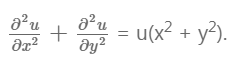
Solution:
Given, u = exy
Differentiating partially with respect to x, we get,
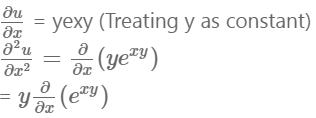
= y(yexy)
= y2exy ……… (1)
We have u = exy
Differentiating partially with respect to y,
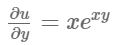
Again differentiating partially with respect to x, we get,
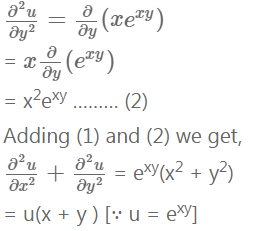
Question 3.
Let u = x cos y + y cos x. Verify 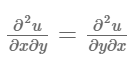
Solution:
u = x cos y + y cos x
Differentiating partially with respect to y, we get, 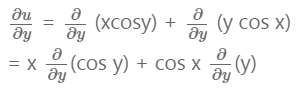
= x(-sin y) + cos x
Again differentiating partially with respect to x, we get
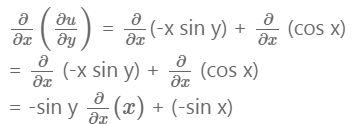
= -sin y (1) + (-sin x)
= -sin y – sin x ……… (1)
Now u = x cos y + y cos x
Differentiating partially with respect to x we get 
= cos y (1) + y(-sin x)
= cos y – y sin x
Again differentiating partially with respect to y we get,
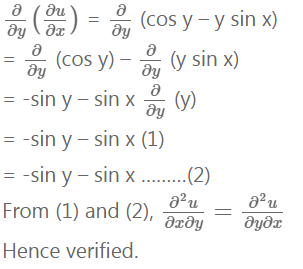
Question 4.
Verify Euler’s theorem for the function u = x3 + y3 + 3xy2.
Solution:
u = x3 + y3 + 3xy2
i.e., u(x, y) = x3 + y3 + 3xy2
u(tx, ty) = (tx)3 + (ty)3 + 3(tx) (ty)2
= t3x3 + t3y3 + 3tx (t2y2)
= t3(x3 + y3 + 3xy2)
= t3u
∴ u is a homogeneous function in x and y of degree 3.
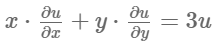
∴ By Euler’s theorem,
Verification:
u = x3 + y3 + 3xy2

= 3x2 + 3y2(1)
= 3x2 + 3y2 …….. (1)
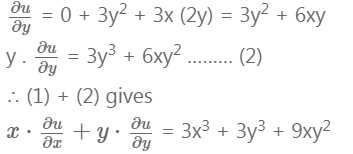
= 3(x3 + y3 + 3xy2)
= 3u
Hence Euler’s theorem is verified.
Question 5.
Let 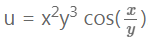 By using Euler’s theorem show that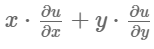
Solution:
Given, 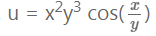
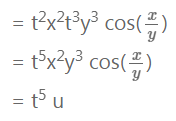
∴ u is a homogeneous function in x and y of degree 5.
∴ By Euler’s theorem,
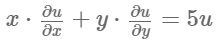
Hence Proved.