

Exercise 9.3 - Chapter 9 - Correlation and Regression Analysis - 11th Business Maths Guide Samacheer Kalvi Solutions
Updated On 26-08-2025 By Lithanya
You can Download the Exercise 9.3 - Chapter 9 - Correlation and Regression Analysis - 11th Business Maths Guide Samacheer Kalvi Solutions with expert answers for all chapters. Perfect for Tamil & English Medium students to revise the syllabus and score more marks in board exams. Download and share it with your friends
Share this to Friend on WhatsApp
Exercise 9.3
Text Book Back Questions and Answers
Choose the correct answer.
Question 1.
An example of a positive correlation is:
(a) Income and expenditure
(b) Price and demand
(c) Repayment period and EMI
(d) Weight and Income
Answer:
(a) Income and expenditure
Question 2.
If the values of two variables move in the same direction then the correlation is said to be:
(a) Negative
(b) Positive
(c) Perfect positive
(d) No correlation
Answer:
(b) Positive
Question 3.
If the values of two variables move in the opposite direction then the correlation is said to be:
(a) Negative
(b) Positive
(c) Perfect positive
(d) No correlation
Answer:
(a) Negative
Question 4.
Correlation co-efficient lies between:
(a) 0 to ∞
(b) -1 to +1
(c) -1 to 0
(d) -1 to ∞
Answer:
(b) -1 to +1
Question 5.
If r(X, Y) = 0 the variables X and Y are said to be:
(a) Positive correlation
(b) Negative correlation
(c) No correlation
(d) Perfect positive correlation
Answer:
(c) No correlation
Question 6.
The correlation coefficient from the following data N = 25, ΣX = 125, ΣY = 100, ΣX2 = 650, ΣY2= 436, ΣXY = 520:
(a) 0.667
(b) -0.006
(c) -0.667
(d) 0.70
Answer:
(a) 0.667
Hint:

Question 7.
From the following data, N = 11, ΣX = 117, ΣY = 260, ΣX2 = 1313, ΣY2 = 6580, ΣXY = 2827. the correlation coefficient is:
(a) 0.3566
(b) -0.3566
(c) 0
(d) 0.4566
Answer:
(a) 0.3566
Hint:

Question 8.
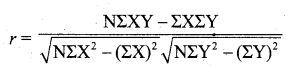
The correlation coefficient is:

Answer:

Question 9.
The variable whose value is influenced or is to be predicted is called:
(a) dependent variable
(b) independent variable
(c) regressor
(d) explanatory variable
Answer:
(a) dependent variable
Question 10.
The variable which influences the values or is used for prediction is called:
(a) Dependent variable
(b) Independent variable
(c) Explained variable
(d) Regressed
Answer:
(b) Independent variable
Question 11.
The correlation coefficient:

Answer:

Question 12.
The regression coefficient of X on Y:

Answer:

Question 13.
The regression coefficient of Y on X:

Answer:

Question 14.
When one regression coefficient is negative, the other would be:
(a) Negative
(b) Positive
(c) Zero
(d) None of these
Answer:
(a) Negative
Question 15.
If X and Y are two variates, there can be at most:
(a) one regression line
(b) two regression lines
(c) three regression lines
(d) more regression lines
Answer:
(b) two regression lines
Question 16.
The lines of regression of X on Y estimates:
(a) X for a given value of Y
(b) Y for a given value of X
(c) X from Y and Y from X
(d) none of these
Answer:
(a) X for a given value of Y
Question 17.
Scatter diagram of the variate values (X, Y) give the idea about:
(a) functional relationship
(b) regression model
(c) distribution of errors
(d) no relation
Answer:
(a) functional relationship
Question 18.
If regression co-efficient of Y on X is 2, then the regression co-efficient of X on Y is:

Question 19.
If two variables move in a decreasing direction then the correlation is:
(a) positive
(b) negative
(c) perfect negative
(d) no correlation
Answer:
(a) positive
Question 20.
The person suggested a mathematical method for measuring the magnitude of the linear relationship between two variables say X and Y is:
(a) Karl Pearson
(b) Spearman
(c) Croxton and Cowden
(d) Ya Lun Chou
Answer:
(a) Karl Pearson
Question 21.
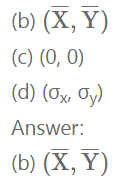
The lines of regression intersect at the point:
(a) (X, Y)
Question 22.
The term regression was introduced by:
(a) R.A Fisher
(b) Sir Francis Galton
(c) Karl Pearson
(d) Croxton and Cowden
Answer:
(b) Sir Francis Galton
Question 23.
If r = -1, then correlation between the variables:
(a) perfect positive
(b) perfect negative
(c) negative
(d) no correlation
Answer:
(b) perfect negative
Question 24.
The coefficient of correlation describes:
(a) the magnitude and direction
(b) only magnitude
(c) only direction
(d) no magnitude and no direction
Answer:
(a) the magnitude and direction
Question 25.
If Cov(x, y) = -16.5, σ2/x = 2.89, σ2/y = 100. Find correlation coeffient.
(a) -0.12
(b) 0.001
(c) -1
(d) -0.97
Answer:
(d) -0.97